Two new improvements to the Comellas record table. Our results reported on 16 November 2026 reach 37,632 vertices at (11,5) and 42,433 at (12,5), exceeding the listed records by 1 and 81 vertices. A fresh check on 18 November 2026 confirms the same gains. Earlier record improvements, including 2,567 vertices at (10,4) and 16,416 at (16,4), retain their original comparison dates.
Each row records an improvement over the public table at the stated time. Later advances extend this record history; they do not change what an earlier construction achieved when reported. Comparison dates and sources.
Latest D5 improvements · reported 16 November 2026
Public table last checked: 18 November 2026.
(Δ,D)
Previous local graph
Latest graph
Local increase
Comellas 2026-11-18
Gain over that table
(11,5)
37,631
37,632
+1
37,631
+1
(12,5)
42,402
42,433
+31
42,352
+81
The final graphs have 205,366 and 246,309 edges, maximum degree 11 and 12, and diameter exactly five, respectively. The 31 D12 insertions improve our previous 42,402-vertex construction by 31 vertices; the gain over the dated public-table entry is 81.
Run provenance: local 2026-11-11 main/v4-maintenance plus DD feedback. The research predates the published v5 workflow and feeds v5 main maintenance, while the fixed v5 tag remains unchanged. On the timeline this is shortened to “Run: v4 + local updates”.
Method and actual checks. D12 preserves the full source as an induced subgraph and adds 31 vertices through legal available-degree attachments. All 31 new vertices were BFS roots in the final graph; old–old distances inherit the accepted source premise. D11 changes the core, so source-edge retention is insufficient: its core distances use the H9 geometric theorem and literal binding, while all 160 old peripheral vertices and the new vertex supply 161 complete BFS roots. Both finals were regenerated exactly; independent finite-array/degree checks passed. Concrete end-to-end Lean instances and required source final-review obligations remain open.
The Comellas table advances as new constructions arrive. On 18 November 2026, it lists 2,614 for (10,4) and 16,848 for (16,4). Our 2,567- and 16,416-vertex graphs remain documented as improvements over the records checked on 5 November 2026. The two D5 graphs above still exceed the table in this latest check.
Joint completion and verified prefixes. Use an inclusion-minimal core-blocking set and jointly complete attachments from the full pool of remaining degree ports. Actual bad vertex pairs guide revisions to earlier construction choices; subsequent work consumes only independently verified prefixes. This research also feeds the Base action Consume results before dispatch: Update current facts from returned evidence before issuing the next task or review, preventing duplicate work and stale-state rollback. v5 follow-up record.
The degree–diameter problem asks how many vertices a simple undirected graph can have when each vertex has at most Δ neighbors and every pair of vertices is connected by a path of length at most D. Earlier ARIS research developed neighborhood extensions, finite-field layers and geometric connection reallocation. The earlier (10,4) result was obtained using MathRSI v2 and its degree–diameter plugin, continuing that research with its saved constructions and failure trajectories. Execution version.
Clone or download the repository and open index.html locally for the interactive figures. GitHub displays the HTML source; this README is the overview to read on GitHub.
Earlier record improvements · 5 November 2026
The following constructions improved four entries in the Comellas table, checked on 5 November 2026. That snapshot includes a 10-regular graph of diameter 4 on 2,567 vertices, exceeding the table's 2,566 vertices.
(Δ,D)
Comellas table
Our construction
Additional vertices
(10,4)
2,566
2,567
+1
(11,5)
37,628
37,631
+3
(12,5)
42,342
42,402
+60
(16,4)
16,384
16,416
+32
The diameter-three constructions cover seven consecutive degrees, from 20 to 26. Their comparisons use the specified published constructions and formulas, including Rajiv, PolarStar, and Delorme's methods. These method-based benchmarks are identified separately from the dated Comellas table records above.
Δ, with D = 3
Published-method reference
Our construction
Additional vertices
20
2,791
3,840
+1,049
21
2,928
3,984
+1,056
22
3,294
4,192
+898
23
3,549
4,336
+787
24
6,144
6,160
+16
25
7,225
7,242
+17
26
7,514
7,532
+18
Across 37 diameter-three parameter pairs, our constructions exceed these specified public-method references. Examples at higher degrees include 56,862 vertices for (54,3), an increase of 1,350, and 414,132 vertices for (98,3). Sources and comparison formulas give the 1 November 2026 literature review and the scope of each comparison.
How the constructions work
1. Extend a graph through covering neighborhoods
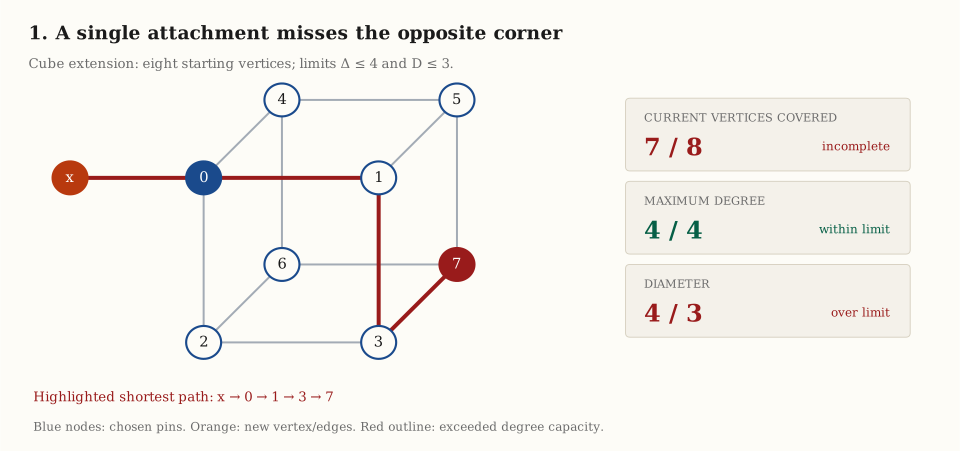
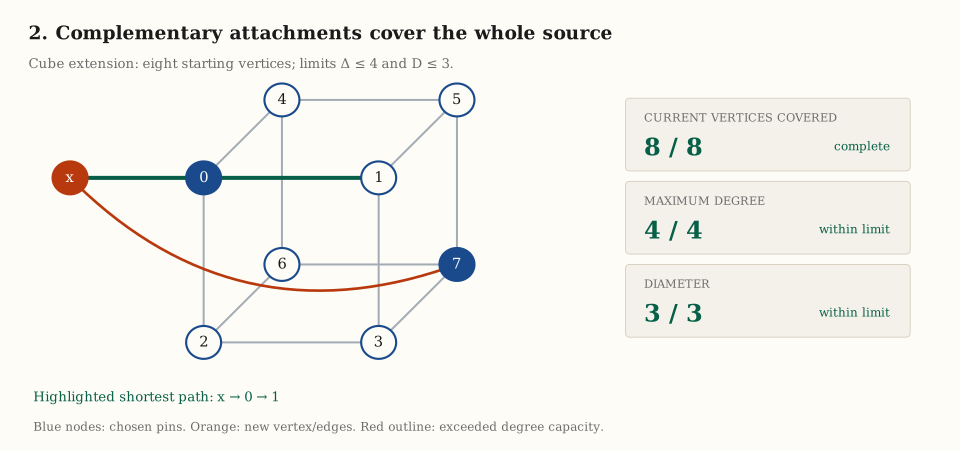
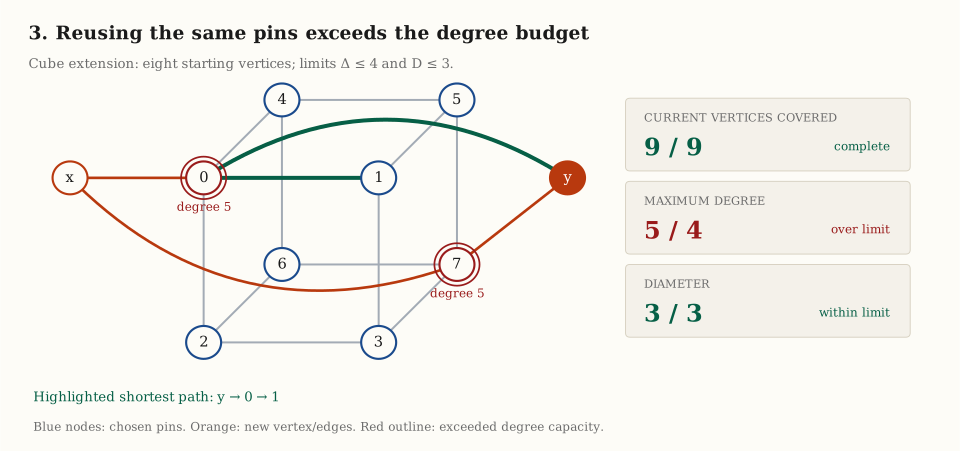
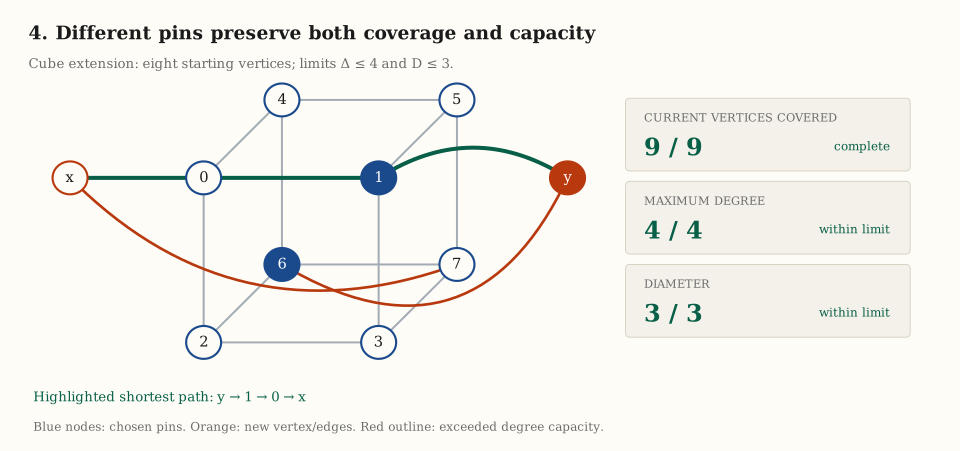
Keep the original edges and connect a new vertex x to a set S of existing vertices. If the radius-(D−1) neighborhoods around S cover the current graph, every vertex is within D steps of x. Each selected neighbor must also have room for the new edge. Repeating this argument gives the D5 extension sequences; neighborhood cloning supports related D3 and D4 constructions.
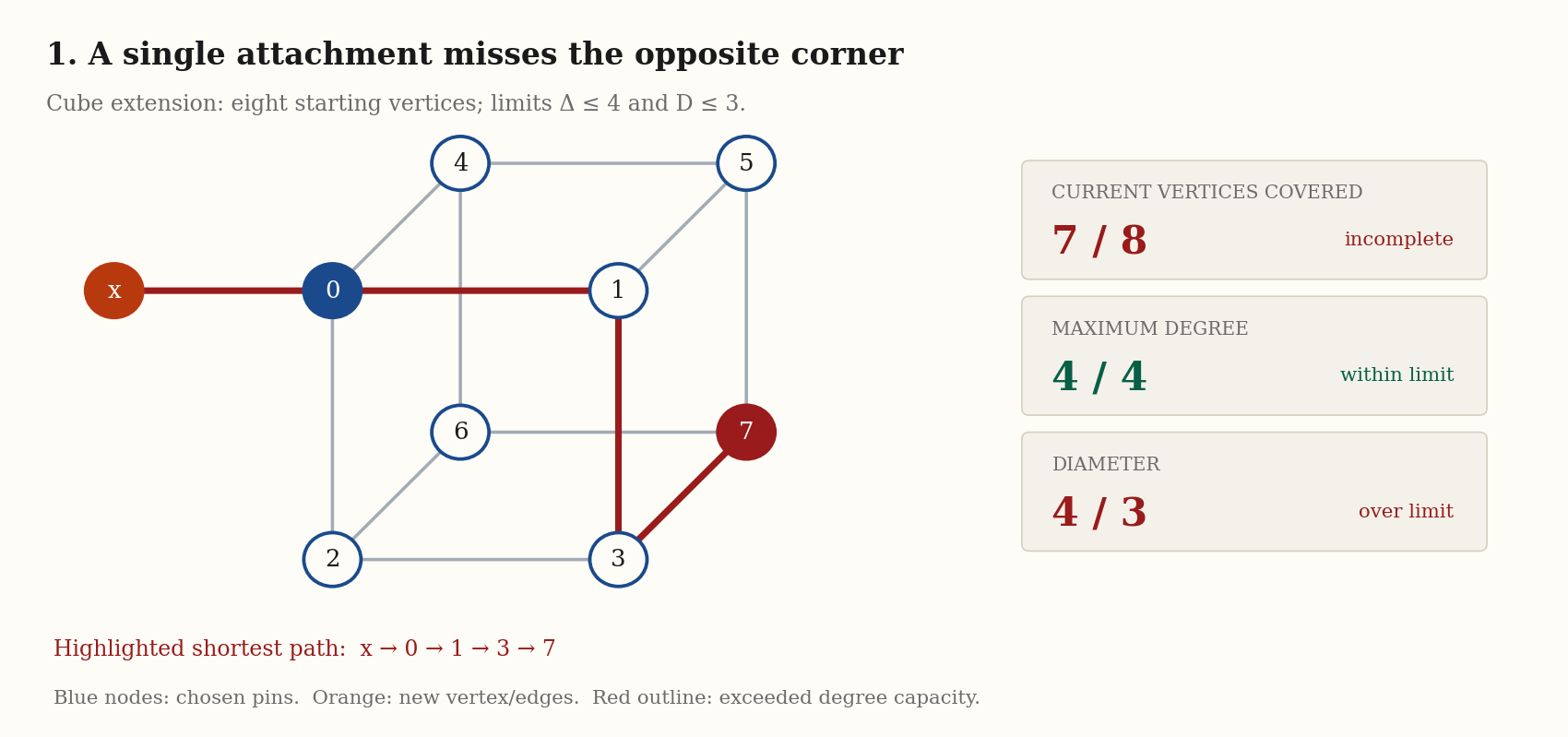
Connecting x only to vertex 0 leaves vertex 7 at distance 4. The degree bound holds, but the diameter bound fails.
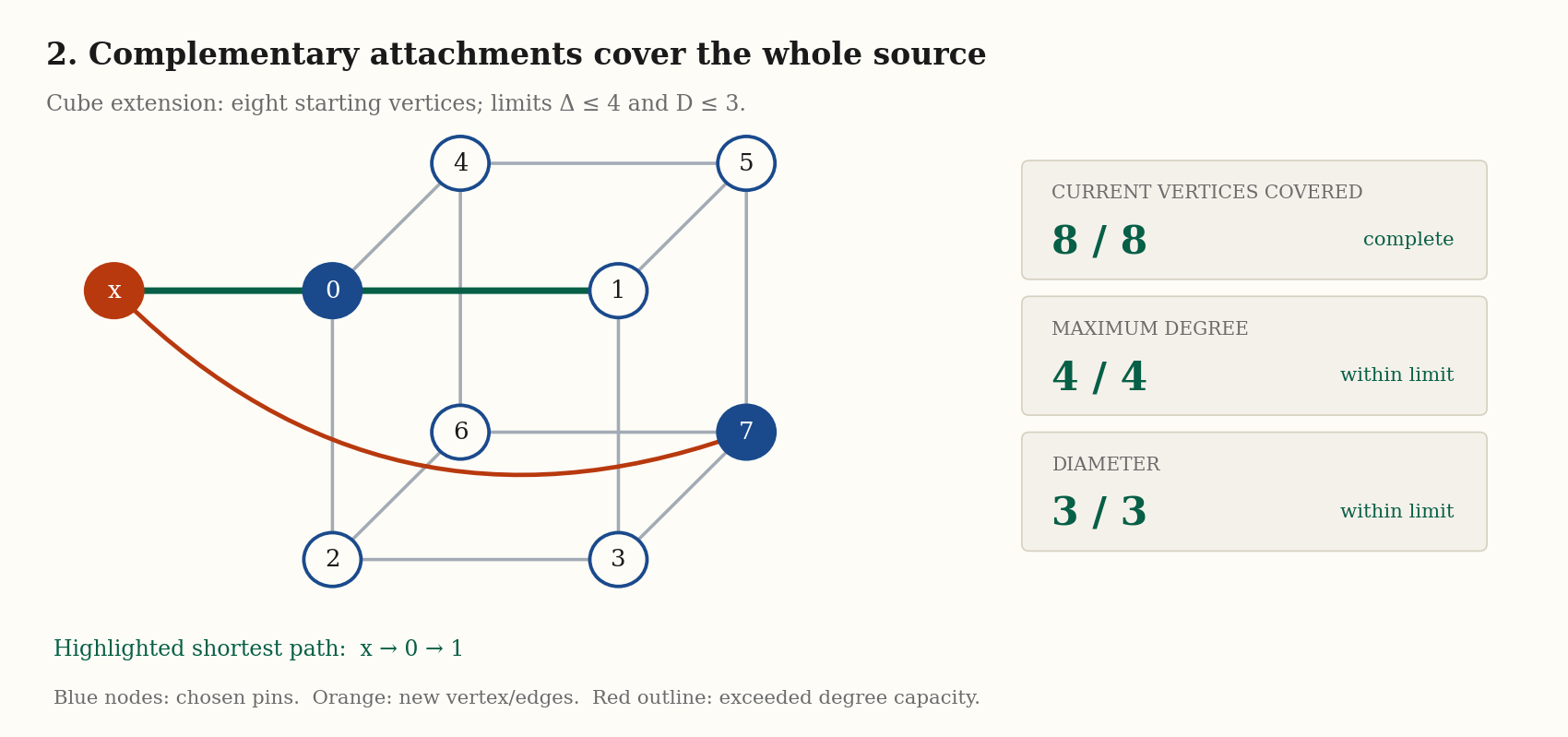
Connecting x to opposite corners 0 and 7 covers all eight original vertices within three steps, with degrees at most 4.
The interactive illustration compares four choices on a cube: one attachment misses a vertex; complementary attachments cover it; reusing the same attachment points exceeds their degree limit; choosing different points allows another extension.
The earlier (10,4) construction extends this idea to a graph with no unused degree capacity. Starting from 2,566 vertices, we remove five disjoint edges and connect a new vertex to all ten endpoints. Every affected old vertex returns to degree 10, and the new vertex has degree 10. Failed point pairs guided the subsequent choices of edges; the final 2,567-vertex graph passes the complete distance check.
The 3,840-vertex, degree-20 graph uses 60 controller states, each carrying the 64 points of F₄³. Five controller ports supply four neighbors each. Compatible affine maps make three-step routes cover the required coordinate layers. Moving from shared parameters to edge-specific maps resolved the compatibility obstacle in the F4 construction.
3. Reallocate geometric connections
Spreads and ovoids in generalized quadrangles organize compatible filling and cloning positions. In the 7,531 → 7,532 construction, 17 clone–filler edges are replaced by 17 edges from a new hub to the fillers. Alternative short routes preserve the distance bound, while the edge count remains 97,750.
The construction builds on source graphs and controllers by Mizuno, Rajiv, Yugeswardeenoo, and Bhakar/f4t4nt, together with Delorme's and subsequent finite-geometry methods. Construction notes connect the illustrations to the underlying arguments and source programs.
What carries over to new problems
The successful steps changed how connections were chosen: combine neighborhoods that cover different regions, allocate degree capacity across all additions, and replace a connection only when the affected routes can be recovered. These lessons turn an individual construction into a starting point for a family of parameters. The proofs, counterexamples and construction programs informed MathRSI's degree–diameter plugin, which connects these methods to the research workflows in v2.
Historical verification and reproduction
The 5 November 2026 catalogue snapshot contains 163 graphs with mathematical or computational verification; 49 have proofs of their concrete graph constructions in Lean, including the 2,567-vertex graph and all seven degree-20–26 representatives. The catalogue includes intermediate extensions, with each parameter comparison using its largest construction.
Graph catalogue: orders, degrees, diameters and verification details for all 163 graphs.
The HTML is generated from this README with ARIS /render-html. Edit the Markdown and run python3 tools/render_index.py from the case directory to update the English and Chinese readers.